Investor opportunities: Prime offices, repricing plays and structural growth sectors
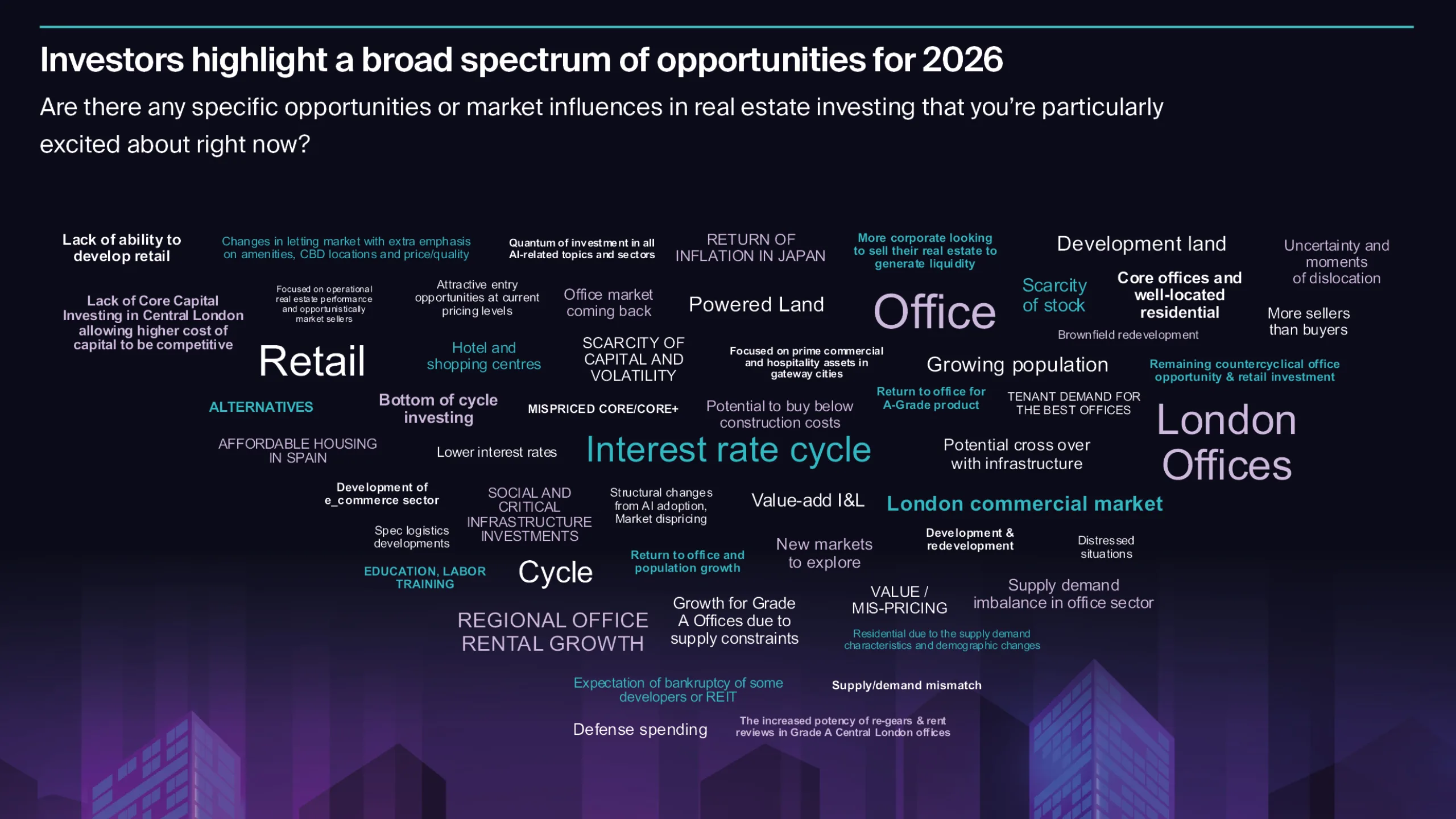
Respondents to the Active Capital Survey 2026 identify three dominant opportunity clusters shaping investor strategy for the year ahead.

Respondents to the Active Capital Survey 2026 identify three dominant opportunity clusters shaping investor strategy for the year ahead.

Survey responses suggest that return-to-office trends and tenant demand for Grade A space are driving renewed interest in prime CBD offices, particularly in London and other global gateway cities. Investors highlight re-gears, rent reviews and selective development for 2028/2029 delivery. as key value drivers. This is likely not a wholesale return however, it is focused conviction where pricing clarity and income resilience intersect.
Click image to enlarge. Source: Knight Frank
Core/Core Plus repricing and distressed situations also form survey respondent free-text responses. Opportunities include sale and leasebacks, bottom-of-cycle acquisitions and assets trading below construction cost. Scarcity of core capital in Central London is also cited as allowing higher cost-of-capital buyers to compete, while motivated sellers in secondary markets offer opportunistic upside. However, as our survey finds, this scarcity of core capital is set to abate in 2026.
Investors are also set to target sectors aligned with demographic and technological tailwinds:
1. Logistics: Supported by e-commerce and supply chain resilience, with Europe and the US as key destinations.
2. Living strategies: Multifamily and co/flex-living dominate allocations, alongside single-family rental. Affordable housing was also flagged as an area of interest.
3. Operational real estate: From data centres to infrastructure, investor responses indicate these are moving from niche to necessity, further supported by free-text responses, offering thematic upside and inflation-hedging potential. AI-linked real estate appears as an emerging theme, signalling the convergence of technology and property.
1. Speed and selectivity to define success: Countercyclical tactical plays in prime offices and retail require rapid execution and conviction.
2. Partnerships will be critical for complexity: The right joint ventures and co-investment structures will be essential to access operational sectors and scale.
3. Thematic diversification firmly on the agenda: Investor responses indicate that logistics, living and operational real estate are structural growth engines, demanding specialist expertise and long-term positioning.
Sign up to receive regular Active Capital insights.
Explore the rest of our Active Capital insights.

Active Capital
Investor sentiment is shifting from caution to conviction following higher interest rates, pricing uncertainty and constrained liquidity.
20 January 2026

Active Capital
The survey reveals how capital flows, sector priorities and strategic positioning will shape 2026.
20 January 2026

Active Capital
How optimistic investors are targeting direct commercial real estate in 2026.
20 January 2026

Active Capital
Offices will be the top targeted sector in 2026. Investors will likely focus on prime assets in core CBDs where there is income resilience.
20 January 2026

Active Capital
The Active Capital Survey 2026 indicates an investor base delicately balanced between caution and conviction.
20 January 2026

Active Capital
Core investment is set to regain momentum, driven by stabilising debt, narrowing bid–ask spreads and improving return profiles.
20 January 2026

Active Capital
Investor hurdle rates follow a hierarchy across strategies. The gap shows liquidity, complexity, execution risk and market volatility.
20 January 2026

Active Capital
Respondents to the survey identify three dominant opportunity clusters shaping investor strategy for the year ahead.
20 January 2026

Active Capital
The Active Capital Survey 2026 identifies seven tightly clustered forces that will define investment decisions in the year ahead.
20 January 2026
Sorry!
An unexpected error has occurred.
Please try again later.