Vusi Thembekwayo, or just Vusi as he prefers to be known, loves to talk. In fact he makes a lot of money out of it, flying around the world – until recently, at least – delivering his motivational monologues for businesses, think-tanks, NGOs and even the United Nations.
At the age of 17 he was granted an audience with Nelson Mandela on his return home after winning a global public speaking competition in the US. Mandela went on to describe him as “the epitome of the South Africa for which we fought”. Former Australian Prime Minister John Howard lauds him as the “rock star of public speaking”.
Luckily, I don’t know any of this when I find myself sitting next to him at the launch of the 2020 edition of The Wealth Report in Kampala where I’m the supposed main event.
Even though Vusi isn’t due to talk – he’s in town to speak at an event supported by Knight Frank’s Uganda business – his reputation would have added to my nerves. However, after I do my bit – to polite applause – he’s goaded into sharing “just a few of his own” thoughts.
"Entrepreneurs and early stage investors simply use the word unicorn in a pitch deck and suddenly the valuation model doesn’t have to follow simple laws of logic."
The audience hang on his every word and afterwards all want to pose for selfies with him. As one of the dragons on a series of Dragons’ Den South Africa, and GQ South Africa’s Business Leader of the Year in 2019, it turns out he is something of a celebrity.
Straight talking
Elsewhere in this report we talk about emerging markets being back on the investment agenda. As somebody who started their career in Africa I find that encouraging, but dig deeper into the analysts’ notes and it always seems to be Asia and Latin America that are the hot tips with Africa more often than not tagged on as an afterthought.
Given the continent’s natural and human capital, that seems short-sighted. Are investors put off by the negative press that Africa seems to generate, and are the headlines warranted, I ask Vusi over a Microsoft Teams call? He doesn’t try to dodge the question.
It’s not a particularly popular comment, but it’s the truth as I see it – I think the average African succeeds in spite of the politicians and in spite of the system, not because of it. So, the things you see reported are true. These things are not imagined. These things are real. The media covers what’s there. You can’t make the story up.
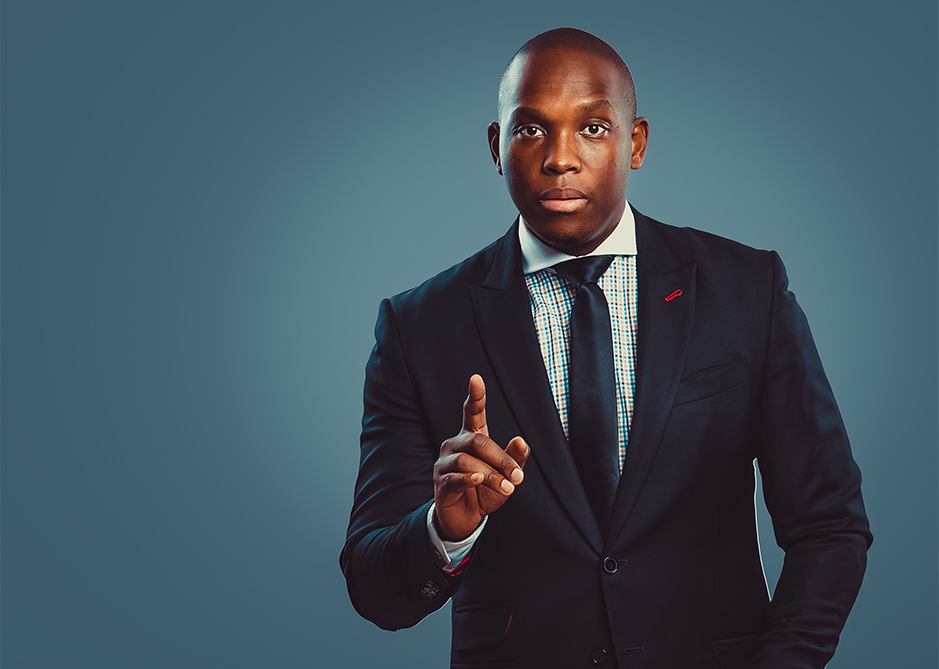
Above: Vusi Thembekwayo
“There’s definitely work to be done to balance the narrative and you see that. CNN’s African Voices, for instance, does great work. The BBC has a platform that does great work too. But what you will often find – often, not always – is that the average person that succeeds and makes it is doing so in spite of the odds, not because of them.”
To rebalance those odds, Vusi says, a new way of thinking is required. “My issue is now and has always been that Africans at one point in time were liberated. Maybe it’s time now that they liberate themselves from being liberated.
"That’s going to require a completely new approach to how we work. A completely new approach to how we collaborate. And a completely new approach to how we think about the role of Africa and the African in the rest of the world.”
Part of the problem, he suggests, is that African economic opportunities tend to be concentrated in a power base of the few. “There is very little room for new space and innovation. And the capital markets are not particularly deep, so even if young people want to do something enterprising, they don’t have the means to do so. Those are the issues that we’ve got to face.”
"My issue is now and has always been that Africans at one point in time were liberated. Maybe it’s time now that they liberate themselves from being liberated."
One of his own personal responses has been to create a venture capital enterprise, MyGrowthFund Venture Partners, which identifies and incubates young entrepreneurs across the continent. Despite some notable successes, the need to cultivate the right mindset remains because many budding business people have got the wrong idea about venture capital, he laments.
“Entrepreneurs and early stage investors simply use the word unicorn in a pitch deck and suddenly the valuation model doesn’t have to follow simple laws of logic,” he wrote in a LinkedIn post.
“So VCs are buying into high-risk businesses that often don’t have a clear path to margins (read profitability), but are in the undisciplined pursuit of more customers and more market share.
“The ‘moral hazard’ is born of the fact that many VCs, even in Africa, are rewarded on the capital they deploy (read manage) and the group-think of not wanting to miss the next big unicorn, often because of the limited personal balance sheet exposure of the fund manager. We also have to deal with this culture of ‘celebrating a successful raise’ rather than a ‘successful year of profits’.”
Future plans
As we chat I can’t help but tell Vusi that I noticed during my research for our interview that #VusiForPresident seems to crop up quite a lot on Twitter in South Africa. Does he have ambitions in that direction, I wonder? “Aspirations, yes,” is the immediate answer. “But not now,” he adds.
“If needed I would be honoured and privileged and I will go where people direct me to go. But it’s certainly not in the wings, not for the next five years or so. That’s not what I’m looking at. My greatest gift, if I am honest, is that I have been given by God the ability to be patient. And on this question I’m happy to exercise that virtue. I’m very happy to wait.”
If he does run for political office in the future, he wants to be able to point to his credentials, he says – and for those credentials to be different to the kind that have traditionally propelled so many of the continent’s figureheads into power.
“I think one of the greatest challenges for Africa has been that Africans have elected popular leaders – a group of people who had liberated their people and ascended to the echelons of power. But the world has changed. The world is not that anymore. Today, the world is no longer binary.
“You’ve got a proliferation of new technologies, you’ve got the collapsing of the global capital market system. Money moves from one part of the world to another in less than a split second and that affects global trade. It affects how organisations are formed.
“Today, you’ve got large companies that are bigger than the size of many mid-size countries. The liberator’s mindset never expected to have to deal with that level of complexity. It’s – and I say this with the greatest of respect – genuinely and honestly a horses for courses thing.”
Continuing to steadily build his track record is the best way to show that he’s the right horse for the course, Vusi tells me. “I do think we need to get to the point where, when Africans elect you, they ask you about your track record. What have you done?”
So how, I wonder, would he hope to answer that question? “We have a particular programme where we’re nurturing the next generation of leaders called the VUKA Foundation. We have the vision of creating one hundred leaders every year for the next ten years.
"The life skill to take into the future is that of empathy. It is sorely lacking in our world today."
“We’ve got our venture capital firm where we’re nurturing the next generation of innovators that are building the future of this continent so that she can become globally competitive and part of the 21st century. That’s my programme. Those are the things that I’ve got to do.”
With hindsight, I wish I had mentioned to Vusi during our interview that The Wealth Report has form when it comes to future presidents – Donald Trump was one of our very first interviewees, long before he stood for office. In the light of his comments on receiving his GQ award, though, I’m not sure what Vusi would make of the comparison.
When the interviewer asked what life skill he thought was most important, Vusi replied: “The life skill to take into the future is that of empathy. It is sorely lacking in our world today. We live in a world that rewards you with ‘street cred’ if you criticise. There are no rewards for empathy.”
Listening, it seems, is just as important as talking.